In lieu of using a photocathode or thermionic cathode or photocathode (as in a real electron gun), which requires ultra-high vacuum for the former and a UV-C (ionizing) light source for the latter, another way to generate free electrons by ionizing air molecules. This is something that can be done, for instance, via a Van de Graaff generator, although any spark generator would do. This, of course, cannot generate a continuous stream of electrons without constantly drawing thousands of volts, but a Van de Graaff machine can create brief sparks of free electrons that could be usable. This page presents a physical analysis to answer the question of whether the idea is theoretically sound.
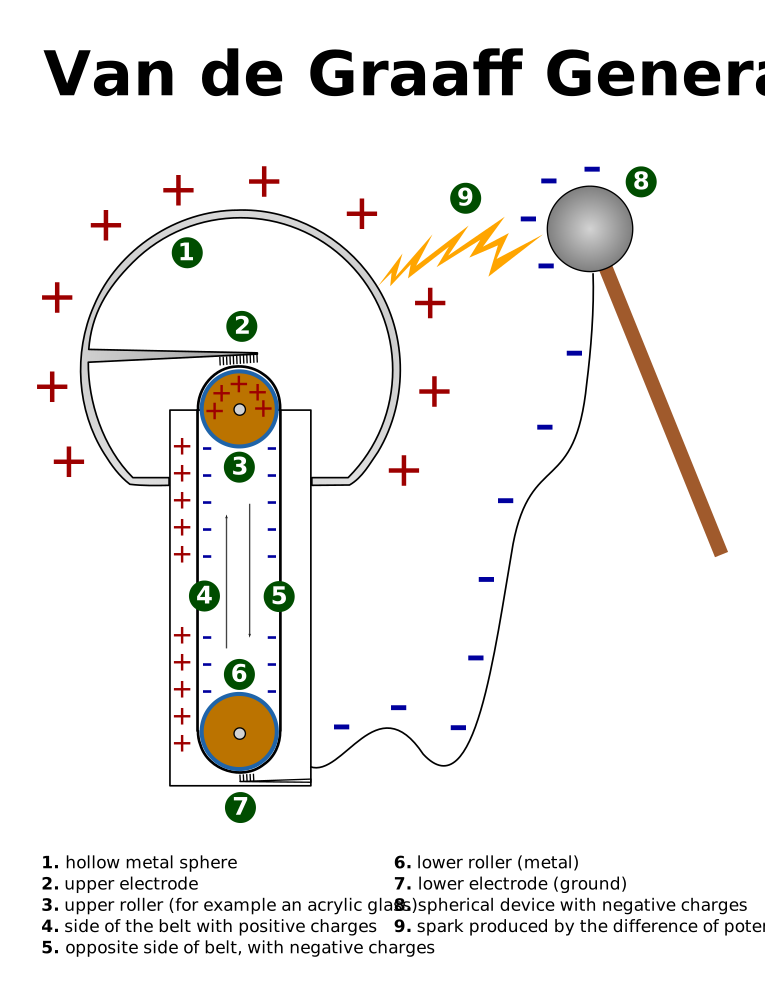
Diagram of a Van de Graaff generator. Source: Wikimedia Commons

Theoretical calculation
The feasibility of using air ionization to produce free electrons depends on whether the free electrons can travel quickly enough to minimize scattering from air molecules, which both reduces the electrons’ velocity and causes them to wander off-course. Let us assume that we are using a Van de Graaff generator, which can produce 250,000 volts, corresponding to an electron energy of and velocity of around , where is the speed of light. We will assume that a magnetic lens is present to collimate the electrons, so that we can ignore the deflective effects of scattering (i.e. we assume the electrons travel on fairly straight paths).
Note: For a more accurate calculation of the breakdown voltage required, it would be preferable to use Paschen’s law.
An inelastic collision between an electron and a gas molecule (in air, for instance, this would mostly be nitrogen molecules) leads to a change in velocity. Given an initial electron velocity of and an initial gas molecule , conservation of energy and momentum gives the (non-relativistic and thus approximate) formula:
Where and denote the final velocities post-collision, and are respectively the electron and gas molecule’s masses. Note that since electrons have such a small mass as compared to the masses of basically any molecular gas molecule, to a good approximation, we have:
The latter equation can be rearranged to find the ratio of the electron’s initial velocity to its velocity following the collision. We denote the ratio as (for “collision ratio”), and it is given by:
We note that when the electron is moving very fast, the second term is negligible, and the electron loses very little speed due to a collision. However, when the electron’s velocity is close to a gas molecule’s velocity, the electron loses much more speed following a collision. The average molecular velocity of a nitrogen molecule in air is given by , where is the Boltzmann constant; in the case of nitrogen molecules (mass = ) at standard atmospheric pressure of 1 atmosphere and room temperature of 300 K, we have a value of around . Following collisions, the ratio of the electron’s initial velocity to the final velocity is given by:
Where is the mean free path of the gas (which for air is around ), and is the total distance the electron has travelled. The falloff is exponential: this means that for a distance of in air, an electron has lost around 63% of its speed, whereas over it has lost 99.995% of its speed. Even if the electron starts out at 74% of the speed of light (around 222,000 km/s), it will have slowed down to just around 12.5 km/s after travelling a distance of 10 cm, and effectively slows to a stop after travelling a distance of 20 cm. This means that the ionization method for creating free electrons is only practical with a very high electrostatic accelerator potential (on the order of 100,000 V) and a short electron gun.
Implementation
The theoretical electron gun could use the following configuration, as illustrated in the diagram below:
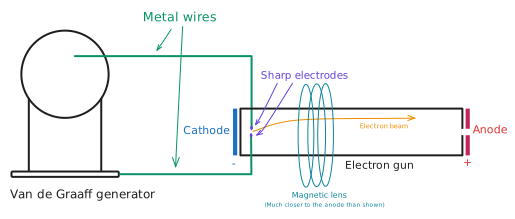
Essentially, the Van de Graaff is connected to two wires; one of which is positively charged (as it is equipotential with the positively-charged spherical shell of the Van de Graaff) and the other neutrally-charged (as it is grounded). The potential difference between the top and bottom wires can be anywhere from 250 kV (for a typical classroom demonstration Van de Graaff generator) to over 1 MV (for specially-designed Van de Graaff generators). If the top and bottom wires are separated by an air gap of length , the voltage required for electrons to jump between the electrodes is around 1. For a separation of around 2 mm, this would only requires a potential difference 6 kV, much below the Van de Graaff’s 250-1000 kV. An electric spark would therefore fly between the two electrodes at the ends of the wires; the air ionizes and generates free electrons (initially) travelling extremely fast ().
The initial motion of the electrons would be in the vertical direction, but would turn via the magnetic lens to move in the horizontal direction, after which they would be accelerated by the anode-cathode potential2. The magnetic lens would also collimate the beam. In theory, this would make for an electron gun that can (to an extent) operate in air, as long as the electron gun is less than 10 cm in length. In practice, it will also depend on how well the magnetic lens can bend the vertically-moving electrons to move horizontally, without the electrons losing speed (due to scattering) in the process.
Footnotes
-
This is because the electric field strength required for the dielectric breakdown of air is well-known to be around . Multiplying by the distance between the electrodes gives the potential difference. ↩
-
This carries the advantage that the electrons will not lose speed, since magnetic fields cannot speed up nor slow down a charged particle. ↩