This page describes our concept plan for launching our space-based solar power systems into space, ensuring their smooth operation, and all the logistics involved.
Please also see Orbital Mechanics for more information regarding space launch and mission planning. Eventually, these two pages should be merged into one page (preferably on this page).
Space vehicle design
If possible, we would love to partner with Elara aerospace (not related to us) and have some of our components ride on their rockets.
Rocket launches
Ocean-based launches are a possibility for safety and efficiency.
Ultimately, Project Elara relies on economies of scale to be able to launch the number of satellites it needs into space. The prototype 1 MW power satellite can theoretically be launched in one piece (barely) if we engineer it carefully (we have launched space mirrors of this size before), but the GW-rated power satellites - the first truly operational power stations, able to each power 750,000 homes - would be more than a kilometer wide, and must require multiple launches and autonomous space construction. Finally, the TW-rated power satellites are behemoths on another scale, more than 10 kilometers wide and each able to power half the planet (at 2019 levels of global power consumption).
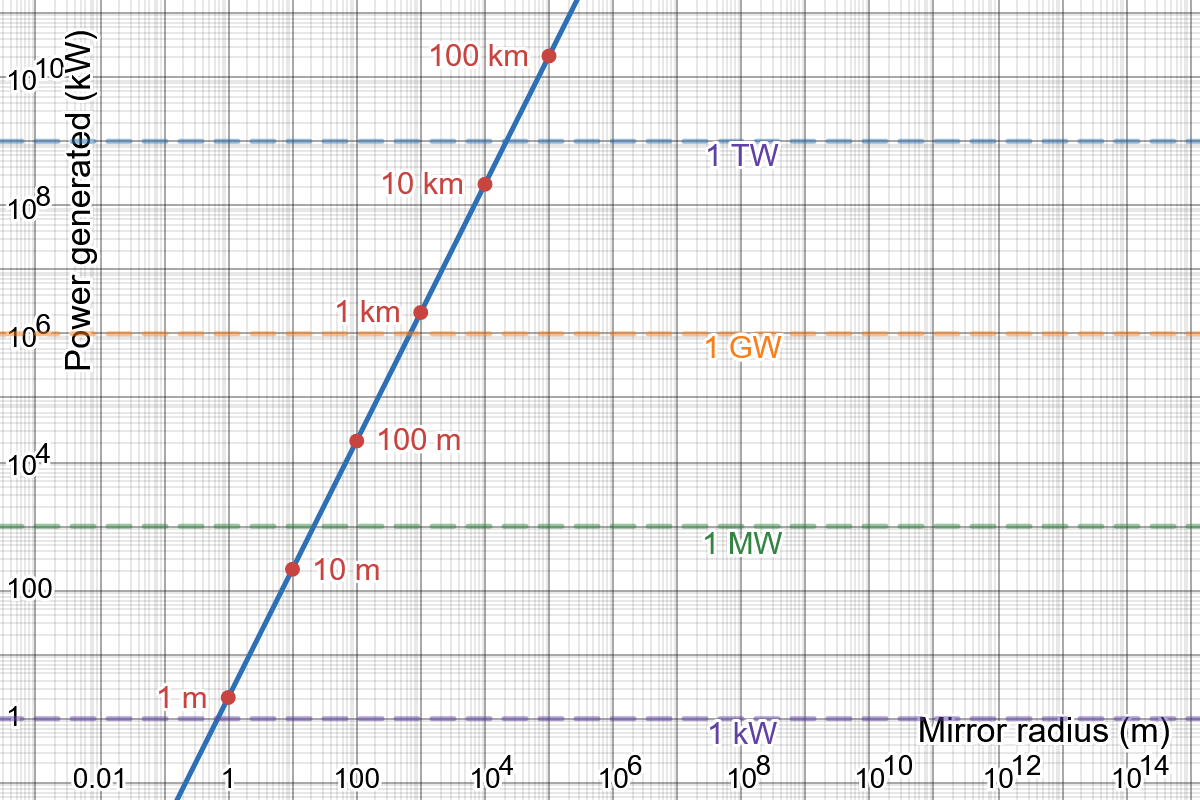
Power generation capability of power satellites according to mirror radius. A live interactive graph is visible on Desmos.
By using the electricity from Project Elara’s existing power plants, electrolysis of ocean water can happen at a large scale to produce the liquid hydrogen and oxygen required for rocket launches at virtually no cost. It can also be used to produce methalox rocket fuel with some modifications with atmospheric carbon dioxide. This can drive down the cost of launches significantly, though ultimately, international collaboration between institutions, labs, and (at some point) space agencies will be necessary to pool together resources to fund the launches. If this does end up being realized, it will be a Manhattan Project-level undertaking - but again, we aren’t in a rush and we believe in building things like a cathedral.
However, given that we still have the problem of money, it is essential that we be as careful as we can and construct our power satellites methodically, testing everything before putting anything into space. We truly have only one shot because we can’t afford to blow up a million dollars (or more). We’ll need to institute a policy that a launch should be aborted if there is anything found pre-launch that’s awry. But if we indeed get the technology demonstrator, and then the 1 MW prototype launched into space, the road becomes much easier from that point on.
Orbit selection
We plan for several different types of power satellites, of different sizes and orbiting at different orbits (some in LEO, some MEO, some GEO) for different purposes. This is due to the different power needs of different locations on Earth. A comparison between several common satellite orbits is shown below:
| Orbit | Advantages | Disadvantages |
|---|---|---|
| LEO | Low beam divergence, can be reached with smaller/cheaper rockets | Heavily-congested region with high possibility for collisions, laser needs to constantly track the ground, significant atmospheric drag requires constant orbital boosting |
| MEO | Less beam divergence than GEO (depending on altitude), requires less powerful rockets than GEO, minimal atmospheric drag | Still requires ground tracking, significant radiation from inner Van Allen belt, may interfere with GPS satellites, laser still needs to continuously track the ground |
| GEO | Relatively uncongested orbit, essentially no atmospheric drag, laser does not need to track the ground | Very high beam divergence, requires powerful/expensive rockets |
Note: LEO=low earth orbit, MEO=medium earth orbit, GEO=geostationary orbit. Note that geostationary orbit is a specific type of geosynchronous orbit (GSO).
Other considerations
Creating employment opportunities
We hope to use the opportunity to be able to employ those who are unemployed and in desperate need of a job to give them an education at Project Elara and the chance to work a paid job in space vehicle design, part assembly, or even as an engineer.
Environmental impact of rocket launches
Using purely LOX/LH2, especially produced via electrolysis of seawater (as described previously), means that the rocket launches themselves will be quite clean: the exhaust is just water and most of it will fall back down to the Earth as rain at some point. However, note that most of it is not all of it; after the rocket passes into the stratosphere, the water vapor can stay as a greenhouse gas.
Avoiding space trash
To not cause additional space junk, we want to use reusable rockets as much as possible, since the primary component of possible space junk from our launches would most likely be discarded rocket booster parts.