WARNING: This is an extremely dangerous experiment. It should never be performed by non-experts without proper training. Any exposure to the UVC lamp can result in serious injury (including but limited to severe skin burns and blindness), so the experiment must be performed remotely. For more detailed information, please see Project Elara Safety Review and Precautions.
Photocathodes are critical to the operation of free-electron lasers/masers, as they provide a powerful electron source, particularly when used in a photoinjector. A photocathode operates on the photoelectric effect, whereby photons from a light source eject electrons from a solid surface, leading to the emission of free electrons. Metallic photocathodes are stable and can be handled at room temperature without specialized equipment. However, they have an extremely low quantum efficiency. This means that even if over ten thousand photons are incident on a metal photocathode, only one electron (on average) is emitted.
Despite this inefficiency, the relative simplicity and safety of a metallic photocathode resulted in it being chosen for Project Elara’s prototype free-electron maser design. The design uses pure zinc as the metal for photoemission. The photocurrent, that is, the net current of the emitted electrons can be roughly computed using the following expression:
Where is the photocurrent, is the quantum efficiency (QE) of the photocathode1, is the elementary charge, is the power of the light source used to illuminate the photocathode, is the speed of light, is Planck’s constant, and are the central frequency and wavelength of the light source. In general, and are known for a given light source, but , the quantum efficiency, is unknown. As the quantum efficiency is dependent on the composition and geometry of the photocathode, it does not have a simple closed-form expression and must be determined empirically.
Experimental setup
To measure the quantum efficiency of a zinc photocathode, a pure zinc plate will be cleaned with IPA (isopropyl alcohol, preferably >99% purity), and then placed between two electrodes. The cathode is then illuminated with a 25-watt UV-C light source, which produces UV-C light at wavelengths of 185 nm and 254.7 nm. It thus emits photons with energies of 6.70 eV and 4.88 eV respectively. This is more than sufficient to overcome the work function of zinc of 4.3 eV2, leading to photoemission.
Two circuit setups can be used, depending on the apparatus used. In the first case, the electrodes are connected to a resistor in series, with a multimeter in parallel, as per the diagram shown below:
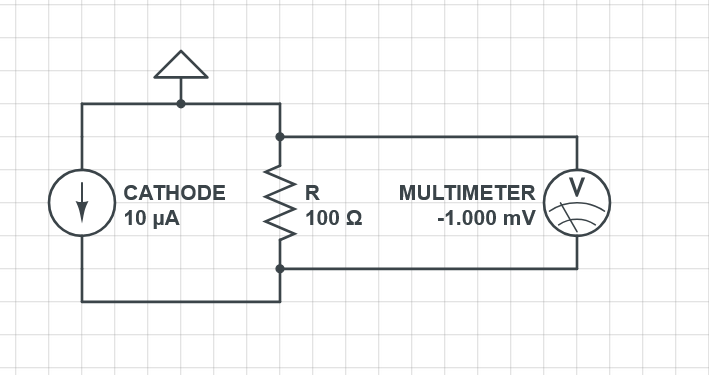
Due to the low photocurrent expected (on the order of ), the multimeter is used to measure voltage instead of current; the voltage can then be easily converted back to current via . This setup is intended for rough testing and may well not be sensitive or accurate enough to show exact results.
A more accurate method utilizes an oscilloscope instead of a multimeter, which can measure much smaller voltages and therefore can dispense with the need for a voltage divider. This allows for precision measurements. The apparatus should be set up as shown below:
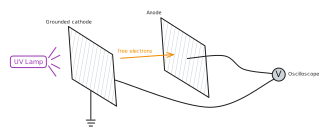
Equipment apparatus and parts list
The experiment will require the following items:
- Zinc plates of thickness
- Electrodes and wires
- 100 Ohm resistor
- Multimeter with sensitivity down to
- Clamps and stand (to hold zinc photocathode in place)
- Distilled water (if possible) for cleaning the zinc photocathode prior to the experiment
- Isopropyl alcohol solution
- Tweezers to manipulate and hold the photocathode
Safety precautions
The light source used is designed for germicidal applications. Therefore, it produces ionizing UV-C light (which can damage skin and cause irreversible eye damage) and ozone (which is acutely toxic and harmful to the respiratory system). Thus, the following equipment/PPE is required to do this experiment safely:
- Fume hood to safely vent away the ozone gas produced, as well as (to a much lesser extent) evaporated alcohol vapor from the IPA
- Long sleeves and closed-toe shoes
- UV protective glasses worn at all times
- Gloves and standard splash goggles should be used when handling chemicals (IPA is an irritant at high concentrations)
- A cool and dry room, as IPA is a fire hazard and ozone is a powerful oxidizer, meaning that fires can burn far more vigorously in the presence of ozone
In addition, in accordance with Project Elara safety regulations (see Project Elara Safety Review and Precautions), a partner system must be used, whereby one member performs the experiment while the other monitors. This is to be done via a direct audio line between the member on the inside of the laboratory and one outside. At regular intervals, a safety callout should be given and responded to, indicating that the experiment has been going smoothly and no adverse issues have been encountered. If an accident occurs, the UV lamp can be shut down remotely via a radio-controlled switch.
Additional references
A complementary description for the experiment is available on this repository. Experimental data and results can be found in this folder.
Footnotes
-
Referenced from the following table. ↩