Note: This page is deprecated as it has been replaced by the Guide to vacuum physics and engineering. It is kept for archival purposes only and is no longer kept up-to-date.
Since our technology (in particular, our maser design) is designed to function in space, we will be testing it in vacuum chambers to replicate the near-vacuum conditions of space. However, as we will need to evacuate the vacuum chambers of air (and thus de-pressurize the chamber), the drop in pressure must be sufficiently slow as to prevent outgassing from causing structural damage to the maser body. Thus, we show a calculation here to determine the predicted stress load on the maser during the de-pressurization process, which can be then used to determine the optimal rate at which air should be evacuated and set structural requirements for material strength.
We will model the maser using a considerably-simplified approximation: a uniform chamber made of a given material, with a gap in the iris aperture, both to allow pressure in its interior and exterior to be equalized, and since it is required for the operation of the maser (see Prototype free-electron maser design for more information).
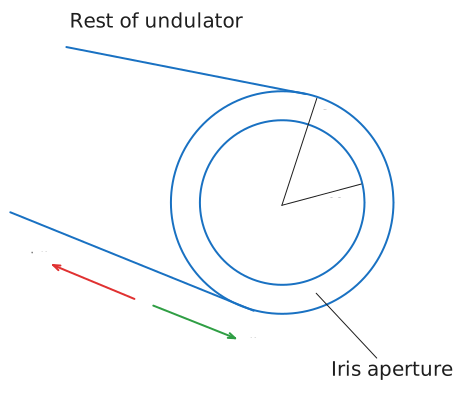
Note: as shown in the above diagram, the axis points away from the aperture and towards the interior of the undulator (equivalently, the axis points out of the aperture and towards the outside of the undulator)
Consider the iris aperture to have the shape of a ring, with inner radius and outer radius . As the pressure decreases in the vacuum chamber, the inside of the undulator will hold onto air more than the outside; this leads to a pressure gradient across the aperture. The pressure gradient will in general decrease as the inside pressure equalizes with the outside pressure. The question is to determine the maximum stress on the aperture during the depressurization process.
Basic mathematical model
Consider a tiny parcel of fluid of cross-section , length , and density . Then, the mass of the parcel would be . However, we know that the fluid exerts a hydrostatic force , so the parcel exerts an infinitesimal force on anything placed within the fluid; it experiences an equal and opposite force of via Archimedes’ principle. Equating the two via Newton’s second law , we have:
We will refer to this as the balance equation (note that is the flow velocity). To solve, we need an equation of state to relate the density with the pressure . For this we can use the ideal gas law , where is the pressure, is the volume, is the ideal gas constant, is the temperature (which we can assume to be roughly constant) and is the number of moles of the ideal gas. The density then satisfies:
Where is the molar mass of the gas, which in the case of air is around . Therefore, the ideal gas law can be rewritten in terms of only pressure, density, and constants (, ) as:
Where is a constant. This equation of state of (that is, a linear dependence of density on pressure) is only approximate; in reality, a gas would cool as its pressure is decreased, and thus temperature would not be constant. However, a high vacuum is a very good insulator and would effectively lead to very little heat conduction, meaning that over time the temperature does stay approximately constant. But if we apply this approximate equation of state, our balance equation becomes:
This makes since, since we know that the fluid flows from the higher-pressure region in the interior of the undulator to the lower-pressure region outside. Thus, the fluid velocity and pressure are related in a manner similar to Fick’s law of diffusion . Since in general the pressure and fluid flow will have both spatial and time dependence, we change the ordinary derivatives to partial derivatives:
Now, by the continuity equation, we know that:
Which, in one dimension (and after substituting in ), takes the form:
We thus have a system of two partial differential equations:
Analytical solution
Let us make the ansatz of , meaning that . Then substituting, we have:
The second equation thus becomes . Therefore, direct integration yields . Substituting into the first equation, we have:
After simplifying and rearranging, we obtain:
Where is a constant, which comes from the fact that we have two ordinary derivatives equal to each other, so both must be equal to a constant. This gives us two differential equations to solve for and :
The solutions are then and where is a constant. Thus we obtain the following solutions:
Let , that is, there is initially no fluid flow across the aperture at the exact moment the vacuum pump is turned on. This gives us . Meanwhile, let , where is standard atmospheric pressure. This gives us . Our solutions thus simplify to:
Via dimensional analysis, must have units of acceleration while has units of inverse time. The initial fluid acceleration is related to the initial force , where is the size of the surface (in this case, the aperture). In particular, it is related also to the mass of the volume of fluid flowing against the surface via:
Where is the thickness of the surface (our aperture), and we used our equation of state . Thus substituting, our solutions reduce to:
In addition, since has units of inverse time, we interpret it as the depressurization rate, where can be interpreted as the mean depressurization time, which is the time required for the pressure to fall to of its initial value. More importantly, we want to find the pressure gradient as a function of time at the boundary (), where in one dimension we have . This gives us:
The maximum of this pressure gradient is at , and is given by:
This pressure gradient has units of force per unit volume; to convert it to force, simply multiply it by the total volume of the aperture (which can be approximated as a thin circular ring/annulus). Meanwhile, the time derivative of the pressure is given by:
This is maximized as well at , which gives:
That is to say, the change in pressure will be most rapid to start with, and thus lead to the highest pressure gradient across the aperture; over time, it will become more gradual, especially as the inside and outside of the undulator equalizes in pressure.
Advanced mathematical model
A more advanced calculation would use the Euler equations governing the flow velocity vector field for a fluid (in this case air), which are given by:
Where we neglect the force of gravity on air as we are considering a small volume of air at the same elevation, meaning it is negligibly affected by gravity. Now substituting our equation of state into the system of PDEs and simplifying, we have:
Note that if we made the approximation that (that is, the pressure only depends on time, not space), then the Euler equations would reduce to:
Solution
In the simplest one-dimensional case, where we only consider the pressure gradient in the direction (see diagram at top of page for the coordinate axes), we have:
Note that the second PDE is almost in the form of the inviscid Burgers’ equation, which has well-known solutions (although, it turns out, in an implicit form that ends up being less than helpful for actually solving the problem). We will now setup an initial-boundary-value problem that can actually be solved.
For this, we will consider a domain with two regimes: the first one for (the portion inside the undulator) and the second for (the portion outside the undulator). For (the exterior region), the pressure is a known, monotonically-decreasing function of time, , which we may take to be linear. For (the interior region), the pressure is an unknown function of time, . That is to say:
We also have:
The first condition , where , is equivalent to saying that the pressure across the aperture is initially atmospheric pressure, and that the pressure gradient across the aperture is initially zero. The second says that the pressure inside and outside the undulator will equalize and asymptotically approach zero, representing a perfect vacuum. Lastly, we have:
- . That is to say, there is no significant airflow/outgassing prior to the depressurization across the aperture
- , which is just a restatement of Newton’s 2nd law , and where is a proportionality factor
- We consider the domain ,
Unfortunately, it does not seem possible to find an analytical solution to or . It is likely that a solution simply cannot be expressed in closed-form for the system, and must be found numerically.