Note: This page has been superseded by Procedure for testing synthetic apertures and is now archived.
In Principles of synthetic apertures we discussed the basic theory and concepts behind the idea of synthetic apertures. As a review, combining two coherent beams spaced apart from each other causes mutual constructive and destructive interference, which creates a much larger effective aperture size. This greatly reduces the divergence of laser and maser beams at long distances, giving a large coherently-combined beam.
Note: See this live demo on Desmos to be able to see a visualization of the effect of combining smaller beams together.
The key results from Principles of synthetic apertures are as follows:
- In the far-field, the effective aperture size is independent of the size of the individual beams used to create it, allowing for creating arbitrarily-wide beams
- The radiation pattern of the combined beam is given by and the first maximum of the interference pattern occurs at (as measured from the center of the beam)
- Beam combining is only possible with coherent light sources (i.e. lasers)
In general, our results are based on very well-known physics and should be physically-sound. However, an experimental test would help us to gain practical experience in understanding synthetic apertures, as well as validation of our calculations.
Equipment
While it would be ideal to test out the idea with actual masers, finding miniature masers is not an easy task as they tend to be bulky devices. Our research hopes to create tabletop-sized devices (see Free-electron maser physics and A realistic space-based prototype for more details), and current research has shown that miniature (solid-state) masers are possible1, but neither of these are ready for use.
Instead, for the first stage of the experiment, it is better to use existing technology. For this, we plan to use He-Ne lasers operating at 633nm, which are well-known for their extremely high beam quality and stability. For a future stage, we may choose to use a hydrogen maser, ammonia maser, or similar highly-stable coherent RF source. We may term the two lasers as “laser A” and “laser B” respectively for identification purposes. The two lasers are then aimed at a photodetector some distance away, which operates similarly to a camera; it captures the radiation pattern of the combined beam, which can then be viewed on a computer. The apparatus is shown below:
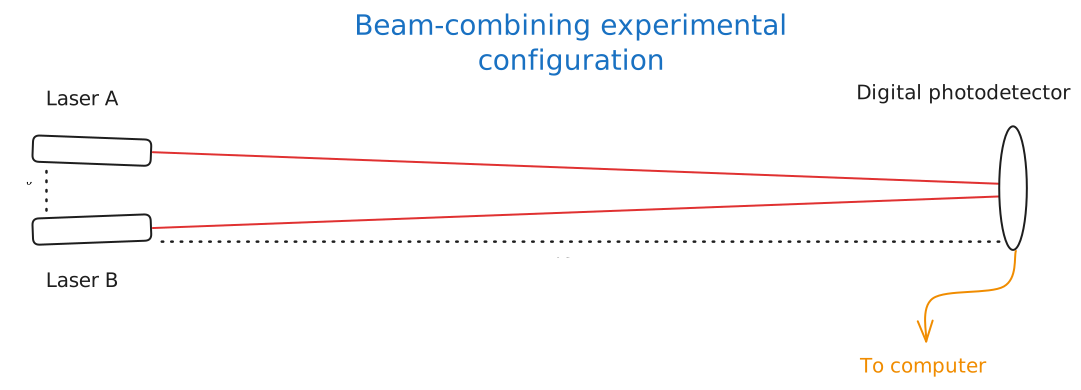
While the basic experiment description is indeed quite simple, the successful execution of the experiment requires highly-precise calibration and measurement. For instance, the experiment must be conducted in a very dark room (optical lab). Additionally, the locations of laser A, laser B, and the photodetector must be precisely fixed, as any deviations will lead to errors in the measurement, and the nanometer-wavelength radiation of visible-light lasers requires extreme precision. Furthermore, since we used the assumption that in the derivation in Principles of synthetic apertures, where is the separation distance between the two lasers, assuming , must be on the order of several meters. This is because the diameter of the primary beam envelope (which we derived in Principles of synthetic apertures) is given by:
Even at , this means that for a 633nm He-Ne laser, we have , which necessitates using a precise, digital photodetector as well as extremely careful calibration (and possibly partial vacuum conditions). Using longer-wavelength light is possible, although the photodetectors would likely need to be switched to those able to measure non-visible wavelengths of light (such as infrared). A comparison of various different laser types, along with approximate values for (assuming vacuum conditions) are given below:
| Laser type | Wavelength of emitted light | Type of light | Approximate value for at | Notes |
|---|---|---|---|---|
| He-Ne laser | 633 nm | Visible | 0.03 - 0.06 mm | |
| Ruby laser | 694.3 nm | Visible | 0.03 - 0.07 mm | Poor power efficiency |
| Nd:YAG laser | 1064 nm | Infrared | 0.05 mm - 0.1 mm | |
| CO2 laser | 10 μm | Infrared | 0.5 - 1 mm | Typically industrial-use only |
| Ammonia maser | 1.26 cm | Microwave | 0.63 - 1.26 m | Needs cryogenic cooling |
| Hydrogen maser | 21 cm | Microwave | 10.5 - 21 m | Extremely expensive |
Note: To account for the nonzero refractive index of air, we must make the substitution . but since we have and thus
To ensure that the positions of each of the two lasers are precisely fixed, laser rangefinders can be mounted along both the longitudinal and transverse axis. This allows precisely measuring the distance from each of the lasers to the centerline (optical axis), as well as their distance to the detector at very high position (and we will need rangefinders with uncertainties of for the experiment to be successful with visible light or for infrared light). In addition, positioning the lasers certainly cannot be done by hand; rather, the lasers must be positioned electronically. The lasers must also operate at low power to avoid damaging the photodetector. Connecting the photodetector to a computer can then record the visual intensity pattern for the lasers, and with the aid of computer vision/image processing tools we can then extract the peak-to-peak distance between the first minima.
Note: For now we should not do the experiment since we probably need to do a literature review on this topic. A particular issue is that it is unclear how one should measure coherent beam combining, maybe you need an interferometer-like setup where the beam bounces between mirrors so that the optical path length is longer(?)
Footnotes
-
From Long, S., Lopez, L., Ford, B. et al. LED-pumped room-temperature solid-state maser. Communications Engineering 4, 122 (2025). https://doi.org/10.1038/s44172-025-00455-w ↩