A free-electron maser is a specific type of maser that is of interest because it is tunable - it can emit different wavelengths, according to need. This gives us a lot of flexibility and means that we don’t have to design for a fixed wavelength.
The free-electron maser consists of an electron beam (produced by something like a vacuum tube) and a specialized arrangement of magnets, called an undulator. In our case, concentrated sunlight can be used as the heat source for the vacuum tube. Electrons from the heated cathode escape from the surface and are attrached to the positively-charged anode, traveling through the vacuum tube at nearly the speed of light. We can maintain the potential difference with either current from external solar panels (not recommended) or through current from a thermocouple (better option) attached to the hot cathode.
The relativistic electron beam from the vacuum tube then passes through the undulator, where the magnetic field causes the electrons to “wiggle” and emit synchrotron radiation (which can be tuned to be in the microwave wavelengths). The undulator is enclosed by two mirrors on either end, creating an optical cavity (much like that of any other laser) that (long story short) creates a collimated beam of photons. We show this below:
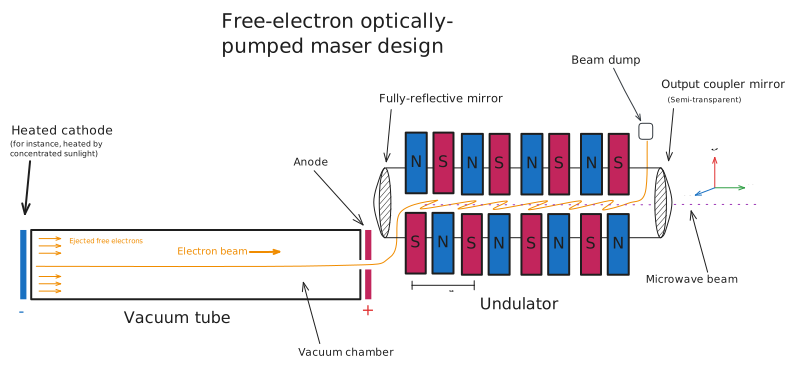
The free-electron maser can be precisely tuned to a desired wavelength, because it doesn’t rely on atomic transitions - instead, it relies on the radiation emitted by the relativistic electrons, and the geometric and magnetic characteristics of the undulator. The undulator strength is often expressed with the dimensionless constant , given by:
Where is the elementary charge, is the electron mass, is the speed of light, and are the tunable parameters, corresponding to the magnetic field strength and the period of the magnets respectively, which simplifies to (amperes per newton) multiplied by . The emitted wavelength of the free-electron maser is given by1:
Where is the Lorentz factor of the electrons, and are the same as their definitions, given before. From Vacuum tube Lorentz factor calculation we find that electron speeds close to 1/50th the speed of light are very possible. In industrial devices, electrons can be accelerated to even higher velocities that approach the speed of light, allowing them to create extremely powerful beams. Since we can tune by varying the geometry and make-up of the laser, we can essentially create whichever wavelength we want, which is extremely useful. However, it is important to note that as increases, the output light from the laser becomes non-monochromatic. Thus, it is important to keep low to preserve the monochromaticity of the light. Since is (approximately) directly proportional to for , and we want relatively long wavelengths for atmospheric microwave transmission, it is best to keep low and high. A script that can be used to calculate values of can be found in calc/free-electron-maser.numbat.
Footnotes
-
See R. Bonifacio, C. Pellegrini, and L. M. Narducci, “Collective instabilities and high-gain regime in a free electron laser”, Optics Communications 50(6), 373–378 (1984) (preprint, Sec. 2). The preprint uses a helical undulator; for the planar-undulator factor with peak-field used here, see K.-J. Kim, X-Ray Data Booklet, Sec. 2.1, eqs. 9 and 11. ↩