This article details the basic steps for building and testing a free-electron maser. The key components of a free-electron maser are:
- An electron source that provides an electron beam
- An undulator composed of alternating magnets
- An optical cavity sealing the undulator, composed of two mirrors at each end of the undulator
Notably all components have to be kept in vacuum or the maser will not work. What follows is a very rudimentary setup for creating a free-electron maser, and hasn’t considered the broad literature on the topic. Consider this a proof-of-concept engineering sketch. What follows is a discussion on the experimental and engineering aspects of each of the components of the maser. The diagram below is available to serve as a reference for the general design of the maser:
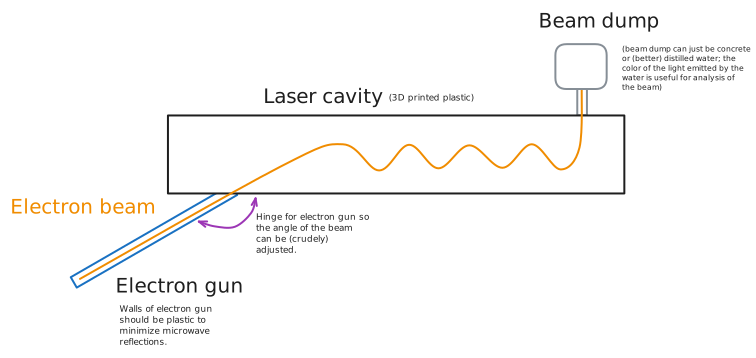
Simplified diagram of general maser design
Note: For more diagrams and information, please see Prototype free-electron maser design.
Suggested shopping list
- Vacuum chamber - note, however, that we need a very good vacuum to make this work, and this is not really something we’d “buy” as much as getting permission to use
- Wires/fasteners
- Zinc plates (for anode/cathode, must be scoured (that is, scraped and polished) or leached with acid prior to experiment and placed in vacuum)
- Circular metal disks used as microwave reflectors
- UV-C germicidal lamp
- N52 neodymium magnets (and we’ll need lots of them)
- Small dish radio antenna with digital interface
- Optical table or at least a table with small holes that allows fastening items to it
- RF-absorbing foam
- Iris diaphragm
Experimental objectives
The point of the concept is to (a) demonstrate that we can indeed build a functional (experimental) free-electron maser and (b) test our our theoretical models with actual results, so we can check discrepancies, identify inefficiencies, and improve our understanding.
Experimental design
The experiment will consist of three parts:
- Working prototype of an electron source producing an electron beam
- Working prototype of an undulator
- Demonstration of lasing for the complete laser system
Part 1: Electron beam
To create the electron beam, we’ll be making something somewhat similar to a vacuum tube. However, instead of relying on thermionic emission (electrons “boil off” the cathode when it gets really hot), we will use photoelectric emission by letting UV light be incident on a metal (likely Zinc) plate. By the photoelectric effect, the UV photons knock off electrons in the cathode, setting them free. By applying a voltage between the anode and cathode with the voltage source, we can create a potential difference between the two electrodes, so electrons fly towards the anode. With a magnet lens (see sextupole magnet), we can collimate the flying electrons into a beam that exits out from a hole in the anode.
Note: Among other reasons, to make sure that the scoured Zinc plate does not rapidly oxidize, everything must be placed in an oxygen-free environment. To more clearly see the electron beam, it might be useful to temporarily pass it through a chamber filled with some sort of noble gas so that the electron beam becomes clearly visible, although the same process causes the electrons to lose energy, so it should only be used for alignment and test purposes.
Depending on need, we’ll then use other sets of magnets to be able to bend the electron beam so it enters the undulator at our desired angle of incidence, and another set to let the electron beam escape after it passes through the undulator (shown in the above diagram). These should be relatively straightforward to set up, especially because our maser will have no moving parts and (in theory) a minimum of electrical wiring required.
Part 2: Undulator
The undulator will be the most important part of the design, but probably the hardest to actually work right. It consists of a set of alternating magnets in two rows (one upper, one lower) that causes the electron beam to “wiggle” and therefore emit radiation, as shown:

From Calculation of free electron maser parameters we know that:
Where is the spatial period of the magnets and is the undulator parameter. Note that for coherent emission of radiation, we must have , and thus:
We recall that the magnetic field between a pairs of magnets, derived in Free-electron maser physics reduces to when the magnets are brought within a distance of each other, and for . In our case, as we are buying magnets of dimensions , the following parameters should be fairly suitable:
| Parameter | Description | Suggested value |
|---|---|---|
| Undulator magnetic field strength | ||
| Separation between upper and lower rows of magnets | ||
| Double of the separation of two adjacent magnets (see Calculation of free electron maser parameters for diagram) | ||
| Applied voltage between anode and cathode | at least | |
| Frequency of maser output radiation | Dependent on parameters |
The undulator field strength decreases with the cube of distance, so raising or lowering the magnets (that is, changing ) into the undulator chamber can be used to change the magnetic field strength. However, the rapid decay of the magnetic field with distance also means that the magnets should generally be brought within of each other, considering the dimensions of our magnets. In addition, increasing in general increases the wavelength of the output radiation of the maser, and thus lowers the frequency. Thus, a maser with large dimensions (large ) is required for emitting long-wavelength microwaves in the range. However, for a prototype, a small can be used to make the maser more compact, at the cost of only being able to produce shorter-wavelength microwaves.
Photocathode characteristics
For simplicity and ease of handling, the prototype uses a photocathode rather than the thermocathode more common among free-electron laser designs (future designs will use a thermocathode, see Thermocathode design for electron gun). The photocurrent can be roughly computed using the following expression:
Where is the quantum efficiency (QE) of the photocathode (also called the photoelectric yield), is the elementary charge, is the power of the light source used to illuminate the photocathode (in this case, a tin cathode), is the speed of light, is Planck’s constant, and are the central frequency and wavelength of the light source respectively, which is found as follows:
Where are the maximum and minimum wavelengths of light produced by the light source, and is the spectral power density (power per unit wavelength) of the light source with bandwidth . Note that and can all be found in the literature1, while technically needs to be determined experimentally, but can be approximated using a Lorentzian lineshape as shown on this Desmos visualization; the integral can then be computed analytically. Some values are listed below for some commercially-available pure metals in vacuum2 (listed from highest to lowest):
| Material | Max. QE () | Literature reference |
|---|---|---|
| Aluminium | 2250 (@58.4 nm), 300 (@121.6 nm), 0.1 - 1 (@355 nm) | Samson & Cairns (1955) (first two values*), Pimpec et. al. (2024) (last value) |
| Lead | 1400 (@80 nm) 300 (120 nm), 5.6 (@213 nm), 12.8 (@193 nm) | Samson & Cairns (1966) (first two values), Smedley et. al. (2008) (last two values) |
| Zinc | 1600 (@80 nm), 1000 (@100 nm), 2.89 (@226 nm), 0.18 (@302 nm) | Samson & Cairns (1966) (first two values), DeVoe (1936) (last two values) |
| Copper | 1250 (@800 nm), 1000 (@100 nm), 0.2-1.1, averaging around 1.0 (@262 nm) | Samson & Cairns (1966) (first two values), Prat et. al. (2015) (last value) |
| Nickel | 1250 (@79 nm), 200 (@120 nm) | Samson & Cairns (1966) |
| Tin | 1100 (@100 nm), 400 (@120 nm) | Samson & Cairns (1966) |
| Magnesium | 1000+ (@100 nm), 20 (@258 nm), 10-20 (@262 nm), 7.6 (@355 nm) | First value is postulated**, last three values are respectively from Teichert et. al. (2021), Nakajyo et. al. (2002), Perrone et. al. (2025) |
| Gold | 800 (@100 nm), 300 (@120 nm) | Samson & Cairns (1966) |
| Silver | 750 (@100 nm), 300 (@120 nm) | Samson & Cairns (1966) |
| Tungsten | 380 (@121.6 nm) | Samson & Cairns (1966) |
*: The first two values were actually of an aluminium-magnesium alloy, containing 94% Al and 4% Mg. **: The postulated value is based on the value of aluminium (from Samson & Cairns, 1966) at around the same frequency, since aluminium’s work function of 4.08 eV is close to magnesium’s 3.68 eV
Note: Several of the older articles are combined in this NASA technical report, which is essentially a compilation of papers, and was the original source that main of the measurements were obtained from. Also, the determination of the values for zinc from DeVoe (1936) was found by taking the y-values in Fig. 3 (which were in units of ), converting them into SI units of , then multiplying them by a factor of to get the QE.
Upon considering these options, zinc may prove to be our preferred option, as it is generally inexpensive and safe to handle, and is a common choice in classroom demonstrations of the photoelectric effect. However, the oxide layer that forms on pure zinc exposed to air reduces its quantum efficiency dramatically. This layer can be removed by simply shaving it off (in vacuum), or it can be removed by immersion in acid; the acid reacts with the oxide layer and forms a precipitate, leaving pure zinc metal behind. However, multiple websites have noted that a mild acid (such as pure white vinegar) is superior to an overly-strong acid, since zinc itself can react with acid; a mild alkali such as toothpaste or baking soda is said to work as well. In addition, scrubbing and washing in water are also methods suggested; see this article for more information.
Alternatively, magnesium can be used. Magnesium appears to form the best photocathodes of any pure metal2 and also forms an oxide layer on its surface, but it is more dangerous to handle as it is an alkali (earth) metal and easily explosive when placed in contact with water or excess moisture. For all cases, it is useful to first clean the metal surface with isopropyl alcohol to remove contaminants, a general technique that is widely-used.
The UV source for the photocathode can, for our purposes, just be a germicidal UV-C lamp, which can reach wavelengths of close to (the lower, the better) and is reasonably affordable. Industrial- and research-grade free electron lasers typically use a photoinjector, which essentially uses a laser as the light source for the photocathode, and can achieve much higher electron beam intensities, but this is out of scope for the time being.3
Electron beam characteristics
Any free-electron maser requires a powerful and usually relativistic electron beam to operate efficiently. The approximate reason for this is that generating coherent radiation requires that the synchrotron radiation in the chamber produces standing waves that are strong enough to exert a “recoil force” back on the electrons (see Free-electron maser physics for details). The power of synchrotron radiation is proportional to the fourth power of the Lorentz factor4, so it is important to accelerate the electrons to (mildly) relativistic velocities (indeed producing such high-energy electron beams is a major reason why typical free-electron lasers are the size of a room5). Since we are using purely electrostatic acceleration, the (total) potential difference required (combination of all the cathode-anode voltages) is quite high, particularly for continuous operation (as opposed to pulsed operation). We assume a potential difference in the order of , where a higher potential difference may be used, but nothing lower.
Undulator strength
For an undulator to produce coherent radiation, another important requirement is that the undulator strength parameter must be small6. Since is linear in and , the magnetic field strength must be carefully tailored to maintain . In practice this means that must be kept relatively small, particularly for operation at long wavelengths where must be large (as we discussed earlier).
RF chamber and output coupling
The undulator takes the form of a resonant cavity (RF cavity) with a mirror on each end; this amplifies the radiation emitted by the rapidly oscillating electrons and through complex physical effects creates a highly collimated beam. Since microwaves have relatively long wavelengths, we do not need to worry much about surface imperfections for the mirrors7. Additionally, the type of mirror does not especially matter, and essentially any type of metal (or metal-coated surface) will be sufficient at the wavelengths we are considering.8. We have put aluminium disks in the suggested shopping list to serve as mirrors, since aluminium is relatively lightweight (compared to steel) and easily obtained.
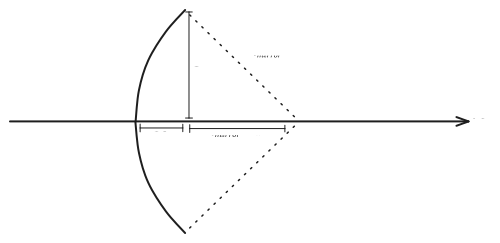
For optics reasons that we will not go in-depth into, the ideal mirrors for a laser (or maser) are curved mirrors (also known as spherical mirrors). The depth of the mirror is related to its radius of curvature and the mirror radius (these two radii are different quantities!) by the formula:
To derive this formula, first note that since the mirror is spherical, every point on its surface is equidistant to its focal point. Therefore, we may create an inscribed triangle, as shown in the above diagram. Then, using Pythagoras’s formula the depth of the mirror may be obtained.
To find a suitable radius of curvature, note that the radius of curvature must be equal to the radius of curvature of the Gaussian beam, which describes the electromagnetic field inside the laser cavity; more information about Gaussian beams can be found in Guide to modelling lasers and masers. The radius of curvature of a Gaussian beam in free space is given by the following expression:
Where is known as the beam waist and is one-half the width of the beam at its narrowest extent, is the wavelength, is the Rayleigh range, and for a laser cavity of length we have:
From these considerations a theoretical value of the mirror thickness may be obtained. It is possible to start with flat mirrors, and then grind the mirrors to make them curved; indeed, this is traditionally how most mirrors were made. This is a tedious process but one that will ensure mirrors of high quality, and if hand-ground, the mirrors may be cheaper than custom fabrication of a curved mirror design.
Note: More comprehensive information on the design and shape of the mirrors can be found on this Codeberg issue.
To be able to transmit part of the microwaves, we’ll need to make a very small aperture (hole, in plain language) in one of the two mirrors.9 This is the output coupler of the maser, and transfers power from the interior of the resonant cavity to the outside. An iris diaphragm is used to be able to adjust the size of this resonant cavity and thus change the amount of power transmitted in the beam. To avoid Fresnel reflections, an anti-reflective RF coating will be applied10, although for practical purposes, this may be a RF-absorbent foam instead of a coating. It is not possible to calculate (in exact terms) how much of the microwaves will be (or indeed, should be) transmitted through the aperture since the problem has no analytical solution. We have done numerical simulations that do give approximate results - see RF cavity simulation with aperture.
A basic calculation of the transmission coefficient in terms of mirror/aperture geometry, however, can be done using the conservation of energy. First, we observe that the energy the passes out of the cavity must be equal to the percent transmitted of the total energy incident on the mirror. That is:
where is the transmittance, are the intensities, and are the cross-sectional areas, where:
Where is the radius of the mirror, is the area of the mirror (excluding the aperture), and is the area of the aperture (of radius ). Now, if we assume that , we have:
This result is of course approximate but a good starting point. For instance, for obtaining around 5% transmission with a mirror of radius requires an aperture size of , while obtaining around 10% transmission can be done with an aperture size of . Any higher amount of transmission and the transmissive losses will too badly degrade the amplification in the resonant cavity; we don’t want to let too much of the microwaves out, leaving too few left inside.
The resonant (RF) cavity can be 3D-printed and should be painted with an EM-absorbing coating everywhere except for the mirrors to absorb any microwaves that are not along the optical axis. This means that only the microwaves along the axis are reflected, thus producing a directional beam; note that in our initial prototype, however, we can omit the EM coating as most 3D print filaments are made of microwave-transparent materials and it is expected that the need for a coating is not yet a substantial area of concern. It will also need slots to be able to put in our neodymium magnets for the undulator, as well as the aforementioned. Other than that, there should be two sets of beam-bending magnets to guide the electron beam into (and out of) the optical cavity. Once the electron beam exits the cavity, it should be directed into an electron dump, which, for our purposes, can just be a concrete block.
Construction and assembly
The maser will be built out of open-source components, including an Arduino microcontroller, various sensors, and a voltage controller. The electron gun assembly is shown below:
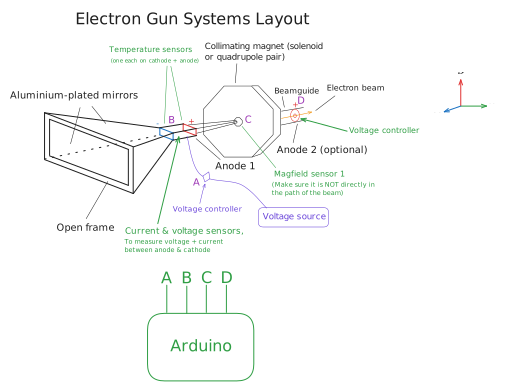
Further information about the electron gun is provided below:
- The voltage controller (as the name suggests) adjusts the voltage from the voltage source, between zero and 2.2 kV, to control the voltage between the cathode and anode
- This will be linked to the microcontroller (shown in the diagram as channel A)
- The electron gun cathode-anode have a voltage and current sensor and temperature sensors to provide system telemetry
- This will be linked to the microcontroller as well (shown in the diagram as channel B)
- The voltage sensor ensures that the supplied voltage (from the voltage controller) is equal to the actual voltage between the anode and cathode
- The temperature sensors ensures that the cathode and anode don’t get way too hot (after all they have a potential of 2 kV between them and the electronics can easily overheat with that high of a voltage)
- The secondary accelerator (shown in the diagram as channel D) is a (much lower potential) anode used to speed electrons up after they exit the collimating magnet
- The 1st magnetic field sensor will be used to measure the magnetic field within the collimating magnet
- The 2nd magnetic field sensor will actually be used to measure current of the electron beam, since the magnetic field around a wire is directly related to the current running through the wire by , where is the distance from the wire
- The microcontroller (i.e. Arduino) will collect temperature, current, and magnetic field data, and feed them via reinforced USB cable to a laptop a distance away; the Arduino will also receive commands from the laptop to adjust the voltage between the cathode and anode (as well as the secondary accelerator)
- The laptop should have a software control panel for displaying the sensor data and widgets to control the voltage, which will be converted to commands to send to the Arduino
Meanwhile, the undulator assembly is shown below:
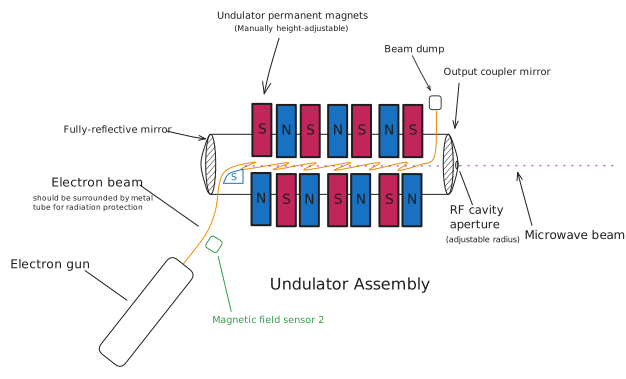
Further information about the undulator is provided below:
- The two mirrors can be made of any type of metal, as almost all metals are microwave-reflective
- While a magnetic field sensor within the cavity would be ideal, it may not be possible to do so considering that the magnets are likely within 1 cm from each other (or less!) and if the electron beam even grazes the sensors, they would be fried
- The manually height-adjustable magnets must be tuned before testing, and are used to adjust the magnetic field inside the undulator, and are designed as follows:
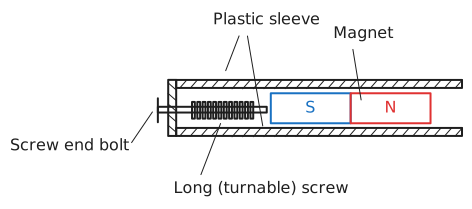
The shielding and safety requirements for the various electronic components are as follows:
- The microcontroller will need to be shielded against beta particles with a mean energy of around 2.2 keV. Refer to this guide for more information on shielding requirements. In general, the requirements are not that high; beta particles can be absorbed with a few millimeters of aluminum11
- As the laser itself produces microwaves, to avoid electromagnetic interference, we should surround the electrical components (e.g. microcontroller) with Faraday cages (likely miniaturized to adapt to the size of the components). Wires can be shielded in the same way (particularly in the wire connecting the laser to the control panel, although it may be more convenient to use thin metal tube(s) as an enclosure for the wires
- All magnetic field sensor probes must be shielded with a non-magnetic material (plastic is fine, but a higher-density material is best). These materials will not block the magnetic field, but they will ensure the electron beam will not cause damage to the highly-sensitive field sensors
- There must be a physical killswitch for the laser (i.e. mechanical) to immediately cut off the voltage if necessary; the system must be fail-safe since it involves radiation and is ultimately a laser with the potential to cause severe injury/death if operated improperly or designed carelessly
More information about the sensors is available at https://codeberg.org/elaraproject/laser-research/src/branch/main/Model%20Drafts/Sensors and at https://codeberg.org/elaraproject/elara-labs/issues/17.
Precautions
It is important to observe the following safety and isolation measures when building and testing the free-electron maser:
- Electron beams can be dangerous as they consist of very fast charged particles (beta particles) which are ionizing. No one should be in the way of the electron beam when it is turned on. It must be operated remotely.
- For the maser to work, it must be placed inside a vacuum chamber at extremely-low pressures. Operating a vacuum chamber is also hazardous and should be done with care.
- The entire maser and all its components (sensors, wires, microcomputers, etc.) must be electromagnetically-shielded (e.g. with Faraday cages) to prevent unwanted EM interference, or otherwise the readings from the antenna will be unreliable. All wires must be properly shielded for the same reason.
Note that these precautions are just a few of the safety measures that should be observed. Other lab safety measures and an experienced research mentor/technician must also be present at all times. Please see Project Elara Safety Review and Precautions for more information.
Data collection and results to measure
To showcase and improve our design, we will need to operate the maser in a controlled environment, and collect test data. Here, a description of the experimental methods and setup required is given.
Experimental setup
Testing the free-electron maser requires techniques that are beyond those required for simply building the maser. It is strongly encouraged to read the page Free-electron maser physics to obtain a good understanding of free-electron masers before continuing on this section.
Electron gun
The electron gun can first be tested individually, with its accelerator potential increased from zero to 2.2 kV. While electron beams are typically invisible, we can visualize the beam from the electron gun by passing it through a clear acrylic block, creating a Lictenberg figure. Likewise, it is possible to operate the electron gun in a low-pressure gas environment such that the electrons occasionally collide with gas molecules, causing luminescence and making the beam visible. Quantitatively, we would also be interested in finding the beam’s cross-section and beam energy, as these parameters give a direct indication of beam quality. A high-quality beam would have a small cross-section and a high beam efficiency (energy conversion efficiency) on the order of , where is the anode-cathode voltage. The cross-section can be measured by firing the electron gun at a phosphor-coated sheet or plate, from which the beam’s diameter can be visually examined.
Meanwhile, the beam energy can be measured in a few different ways. One way is to use the traditional particle detector/cloud chamber method of bending the beam in a homogeneous magnetic field and using the beam’s radius of curvature to find the velocity, from which the energy is simply . Alternatively, a scintillator can be used for this purpose, although it would be much more expensive and complex. Another way is to use an infrared camera to measure the temperature of the region of air surrounding the beam, from which the average energy can be determined via the famous kinetic theory equation:
Where is the number of moles of air within a fixed volume, is the ideal gas constant, and is the total number of particles within the same volume. Note that this method also works if the beam is aimed at a thermally-conductive material, although the equations would be different.
Vacuum chamber
As with any free-electron laser (or maser), vacuum conditions are required for the design to work. The need for vacuum comes from the simple fact that an electron beam is easily scattered by any air molecules present. In more technical language, without vacuum conditions, the mean free path for electrons is very short, preventing the formation of a collimated beam.
Ideally, ultra-high vacuum would be used, since it is similar to conditions in geostationary orbit12. This would be anything from (on the low end) to (on the high end). However, ultra-high vacuum requires complex, expensive equipment that can cost thousands of dollars or more. High vacuum () is much easier to achieve, and should be enough for our purposes; moreover, it can be reached via a mechanical pump, which are much more readily available, and second-hand ones can be found online.
Note: Here, “high” refers to the quality of vacuum; a “higher” vacuum is one that has lower pressure (and is therefore closer to a perfect vacuum).
A comparison of different vacuum types and the types of equipment needed to achieve them is shown below:13
| Type of vacuum | Pressure | Equipment required |
|---|---|---|
| Low vacuum | Mechanical pump | |
| High vacuum | Mechanical pump | |
| Ultra-high vacuum | Mechanical + turbomolecular pump | |
| Extreme-high vacuum | Mechanical + turbomolecular pump + ion pump |
Note: We would like to thank Professor Humberto from RPI for his advice regarding the equipment necessary to achieve various types of vacuum. In addition, we would like to thank Michael from the Gaerttner LINAC center for speaking to us and giving us information about the requirements of the vacuum pump we would need to use (see this issue for more details on the discussion).
For initial testing, it is likely best to start from low vacuum to test the structural integrity of the undulator and electron gun housings (without the magnets and electronics initially), for practical and cost reasons. The pressure may then be lowered in increments, and the parts checked for any structural weakening or structural failure. This allows testing to begin almost as soon as 3D printing of the undulator and electron gun housings is complete. However, for electron beam operation, high vacuum is the minimum required, and ultra-high vacuum is preferable whenever possible.
RF shielding requirements
RF shielding will be important for accurate measurements, because it is near-certain that this first experimental prototype will be extremely low-efficiency and thus produce a weak microwave beam (on the order of a watt or even lower; note, however, that this is still already more than a million times that of typical gas masers, and if focused, can cause burns). Moreover, our target microwave range is close to typical frequencies for telecommunications equipment and Wi-Fi. Thus, it goes without saying that the entire experimental setup must be completely shielded (e.g. via a Faraday cage) and we cannot use phones, computers, or other similar electronic devices anywhere close to the experimental apparatus, other than specially-shielded instrumentation and electronics.
Microwave measurements
For the best results, the test should be performed in a shielded anechoic chamber to obtain accurate measurements, as is standard for testing RF antennas. However, with even small anechoic chambers costing several hundred or even thousands of dollars, this is not practical for our purposes. A slightly more affordable option is to buy slabs of pre-manufactured RF absorbing panels, which are typically carbon-loaded polyurethane foam cut into pyramidal wedges, and are used to coat the walls of anechoic chambers. This, however, is also expensive, though slightly less so. Another option is to use a RF-absorbent material like carbon-loaded foams to line the test chamber, such as this activated carbon foam sponge sheet. While the efficacy of such materials is generally unknown, they are the only option within our price range.
Note: It may be possible to try to calibrate for the imperfect reflections caused by the RF absorber and use that to reduce the noise caused, but there is no guarantee this would succeed.
Meanwhile, outside the chamber, a Faraday cage (or equivalent) can be used to block external EM fields and minimize interference. Note that a common rule of hand is the one-tenth rule; that is to say, a mesh made of a conducting material with a gap of effectively blocks electromagnetic fields just as well as a solid conductor. Using metal wiring (which can be bought quite cheaply in wire rolls), we can therefore create a mesh that surrounds the testing chamber and shields it from external interference.
One last option worth considering is to use liquid water as a microwave absorber. Water in liquid form is an extremely powerful microwave absorber (particularly saltwater) and strongly attenuates microwaves. It may be possible to surround the test apparatus in water tanks, or place the test apparatus in a waterproof box that is then submerged in water. This method is inexpensive, water is readily available, and it removes the need for a Faraday cage and for RF-absorbing foam, at least in theory. We have performed some tests and their results appear to be promising.
Nevertheless, background readings of the EM field with the maser turned off must be conducted to measure any remaining background noise, and ensure that noise does not overwhelm the readings. After the experiment, the noise may be removed from the experimental data to obtain cleaner results.
For our maser design, the key parameters to measure are the following:
| Parameter | Measurement method | Ideal result |
|---|---|---|
| Radiation pattern | Test antenna | Gaussian intensity profile |
| Frequency range | Test antenna | Narrow range, centered at the lasing wavelength |
| Electron beam leakage | External Geiger counters | Very low; if there is any ionizing radiation significantly greater than background, then we must locate the source of the leakage, reinforce the relevant section(s) around the source, and add more shielding |
| Magnetostatic fields inside undulator | Built-in gaussmeter in the undulator | Close to the computed analytical and numerical solutions; see Numerical simulations for magnetostatics and Numerical modelling of electron beams for the specific solutions |
| Electron gun anode-cathode potential | External voltmeter | Close to the operating potential of the beam; for instance, for a 2.2 keV beam, this would be 2.2 kV |
| Beam current | Built-in current sensor | Close to the theoretically-predicted value of the photocurrent |
| Temperature of wiring, electron guns, and microcontroller(s) | Built-in temperature sensors | Generally low; if detected temperature is overly high, then the electrical components may overheat and short-circuit |
| Optical noise (variation in power output of the maser) | Test antenna | Generally low, ensuring the beam is stable |
| Operation time | Timer | As long as possible; the maser should be capable of continuous operation over extended durations |
Note: For obtaining the radiation pattern, the test antenna would be moved at equidistant intervals in a rectangular or polar sampling grid to find the radiation pattern.
Other parameters can then be experimentally determined from the results, as follows:
| Parameter | Determination method | Ideal result |
|---|---|---|
| Central wavelength | Center of frequency range | Equal to , the lasing wavelength, and , the wavelength of the fundamental mode of the laser cavity |
| Bandwidth | Width of frequency range | Very small, since a free-electron maser is a coherent light source |
| Gain | Gain formula combined with measured radiation pattern | Very high gain on the optical axis, with a maximum gain of |
| Total output power | Integrating the radiation pattern across all solid angles | Equal to the input power |
| Efficiency | Dividing the total output power by the input power (power supplied by the UV light source) | >50% efficiency (not realistically possible) |
To collect our data, we will need to rely on an antenna placed in front of the maser that can pick up the maser’s microwave beam and therefore measure both its wavelength and signal power. This is the test antenna, and can take the form of a small dish antenna (similar to those used for receiving satellite TV or radio) that is reasonably mobile and has a known gain. Ideally, the antenna would be connected via a coaxial cable to computers located outside of the shielded vacuum chamber used to test the maser; however, if a physical link cannot be established without compromising the quality of the vacuum inside the chamber, then the antenna would need to be linked to a microcomputer for storing data until after the maser is turned off. In addition, if it is not possible to use a transparent vacuum chamber, miniature TV cameras may be used to obtain a live video feed. However, note that wireless remote control or data links must be avoided as their radio waves/microwaves may cause interference with the microwaves from the maser.
For the measurement pattern of the radiation pattern in particular, it would be necessary to move the test antenna to different grid points along a polar grid (from left to right). This is a non-trivial measurement to perform; consult this video and these notes for more information. Needless to say, we will also need to connect the test antenna by a well-shielded coaxial cable to a device outside the vacuum chamber and shielding, even as we move it to different locations around the maser. The specifics will be determined at a later time.
Maser control
The primary way we will be controlling the maser’s beam characteristics is by varying the separation between the pairs of magnets, which yields a change in the wavelength approximately proportional to .
We can also vary the distance between the upper and lower rows of magnets in the undulator, which can be used to adjust the magnetic field strength. The dependence of the magnetic field on the wavelength is not a direct relationship, but a stronger field in general increases the wavelength (slowly).
In addition, we can vary the voltage applied between the anode and the cathode. Increasing the voltage increases the Lorentz factor of the electrons (as they move faster) and should yield a (very small) change proportional to in the wavelength of the emitted radiation by the equation - see Calculation of free electron maser parameters for more on this.
Finally, the iris aperture can be adjusted to increase the amount of the beam that exits the resonant cavity. We again will restate that the dependence is highly complex and cannot be easily modelled analytically, although it is expected that
As a summary of the expected response of the maser to variable changes in its parameters, we have:
| Parameter | Symbol | Effect on wavelength | Effect on maser power output |
|---|---|---|---|
| Spatial period of magnets | Increase leads to longer wavelength | No effect (in theory) | |
| Distance of undulator magnets from beam centerline | Increase leads to stronger magnetic field | Increase leads to higher microwave beam power | |
| Cathode-anode potential difference | Increase leads to shorter wavelength (due to higher Lorentz factor) | Increase leads to higher microwave beam power | |
| Iris aperture radius | No effect (in theory) | Increase leads to higher microwave beam power | |
| Number of magnets used (per row) | Increase leads to more uniform magnetic field | Increase leads to more stable beam |
Last but not least, the maser must have a SCRAM button for quickly shutting it off in case something goes wrong. There must be a physical switch as well as a digital switch for redundancy, in case one does not work. Before the operation of the maser, a safety briefing must be conducted, and the maser must be run with care and due caution.
Magnetic fields
We would ideally want to determine the actual magnetic fields of the magnets, which may deviate significantly from our theoretical result of . For this, a rather crude way is to use iron filings and photographs to be able to trace the field lines, although this is only useful for a visual inspection.
More realistically, we would take readings from the built-in gaussmeters in the maser at different positions and fit the measured values against theoretical models (as given in Numerical simulations for magnetostatics).
Resources
Tables of magnetic remanence (permanent magnets):
Other tables:
Other useful links:
Measuring instruments:
Footnotes
-
See this site, with the data produced by the company Opsytec for spectra of common UV light sources. ↩
-
This does not include metalloids like silicon and germanium, which can have much higher quantum efficiencies when carefully treated, but are also far more difficult to handle. For a overall review of photocathode materials, see Schaber et. al, Review of photocathodes for electron beam sources in particle accelerators. ↩ ↩2
-
For more information on photoinjectors, see Rao et. al. (2014) ↩
-
The formula for the radiated power for synchrotron radiation is given by . It comes from the synchrotron radiation Wikipedia article but is well-known. It can be clearly seen that (at least approximately, for large , after you realize that ). ↩
-
This comes from this CERN publication, which states “There are a number of reasons why the FEL has attracted scientists…[but] the price to be paid is the high quality electron beam needed to drive an FEL…[leading] to large and expensive systems” (Gaupp, 1995) ↩
-
See this Physics SE answer or Jackson’s classic text Classical Electrodynamics (granted, Jackson’s arguments are very rarely easy to understand). ↩
-
From this interactive tutorial, “…when surface imperfections are smaller than the wavelength of the incident light (as in the case of a mirror), virtually all of the light is reflected equally.” So we don’t have to machine things super super precisely. ↩
-
From Physics of the Microwave Oven (Vollmer, 2004) (alternate link), “…the refractive index of many metals gives reflectivities close to 100% at low frequencies…” Thus the type of metal does not matter and it should not be necessary to polish the metal. ↩
-
So-called hole-coupled free-electron lasers are common for infrared FELs, where conventional partially-transmissive mirrors are not easily-manufactured (see Varro et. al., Free Electron Lasers ,Ch. 3, pg. 68). The principles of free-electron masers are quite similar to nfrared FELs, and thus the same ideas carry over. ↩
-
See this article on Fresnel reflections as well as the description on this page on output couplers. ↩
-
From this Wikipedia article ↩
-
Source: https://www.leybold.com/en-us/knowledge/blog/vacuum-space-research ↩
-
Source: table from https://en.wikipedia.org/wiki/Orders_of_magnitude_(pressure) as well as https://www.leybold.com/en-us/knowledge/vacuum-fundamentals/vacuum-generation/ultra-and-extreme-high-vacuum ↩