As we know, the Helmholtz equation is the time-independent wave equation, obtained after separation of variables of the electromagnetic wave equation. The most well-known of the solutions of the Helmholtz equation that describe laser light is the Gaussian beam, which we explored in Ideal laser beam divergence. However, a Gaussian beam diffracts, meaning it always diverges, and furthermore, there is a fundamental limit (the diffraction limit) to the spot size that a Gaussian beam can be focused to (which we also calculated in that same article).
Thus, we want to extend our search to non-diffractive solutions of the Helmholtz equation. The naive solution would be that of the plane wave, but creating a plane wave is impossible (for a lot of different reasons), so it is not a particularly meaningful solution for our purposes. An intriguing possibility that has had on-and-off interest is the Bessel beam, whose (scalar) form is given in cylindrical coordinates by1:
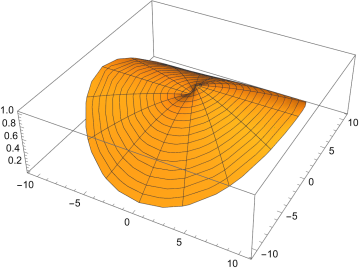
A Bessel beam’s cross-section resembles a cone in nature, since its cross-sectional intensity profile is that of a Bessel function:
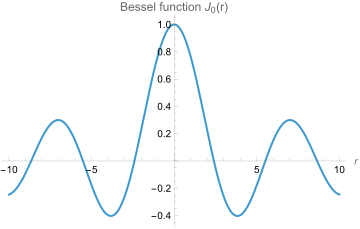
A cross-sectional plot of the Bessel beam (for fixed ) is shown below (and the code is available in the notebooks/bessel-beams.nb Mathematica notebook in the elara-labs repository):
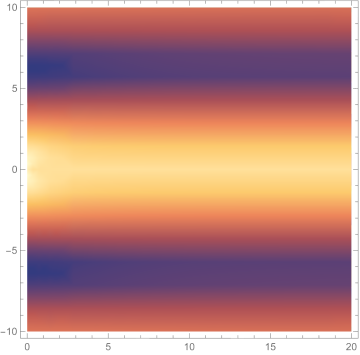
Bessel beams do not diffract - their intensity profile along their propagation axis (that is, ) stays constant along all . We can see this in the cross-section density plot below:
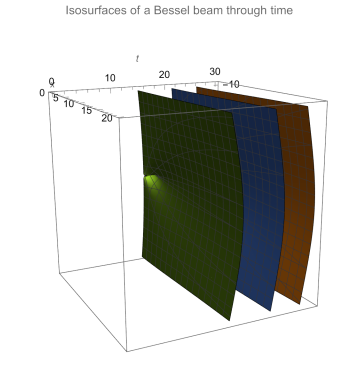
And even more clearly in the isosurface plot shown, where we should note that is left-right axis, that is, the plot shows slices of the beam through time:
Unfortunately, Bessel beams are unphysical in nature, and this is precisely how they are able to be non-diffractive. One can understand a Bessel beam as an axially-symmetric superposition of plane waves. Like a plane wave, a Bessel beam takes infinite energy to create, so it is only a theoretical idealization.
Thus we come to the conclusion: All realistic beams are diffraction-limited. In the context of laser (or any electromagnetic beam-based) power transmission, this means that some power loss is always present. The best we can do for long-distance power transmission is to concentrate the cross-sectional intensity along along the transmission axis - for instance, by finding electric-field solutions in the form for large (this is in cylindrical coordinates, where the beam’s propagation axis is taken to be along ). For instance, if 70% of a beam’s intensity is kept within a reasonable cross-sectional radius , we have something that can be considered “good enough” (the theoretical limit is for a Gaussian beam).