For Project Elara’s power system to be useful, it is not enough to just collect solar energy from space and transmit it by means of a microwave laser (maser); in addition, it must be received on the Earth’s surface by various types of receivers, from small, easily deployable receivers pressed into flexible sheets for powering remote regions, to city-sized power stations in the ocean, to specialized types of receivers for emergency workers and humanitarian aid. Hence, the understanding of different types of technologies for receiving microwave (RF) power from space is essential.
Note: This is a theory-focused page, and as such will not cover the rectenna/antenna designs used in Elara’s power receiver system. Please see Power receiver engineering for that information.
Parabolic antennas
Parabolic antennas are the first method we will use in power receiving. They are useful for high-intensity direct beaming, either in locations with pre-existing telecommunications antennas (e.g. decommissioned TV/satellite radio dishes, which can be modified to become ground-based power receivers), or in specialized locations (e.g. on ships or seaborne platforms).
The mathematical basis for parabolic antennas is the same as that of those used for the parabolic mirrors. As described in Solar mirror engineering, the electric field of the parabolic antenna is given (in time-independent form) by:
Where is a Bessel function of the 1st kind, is the diameter of the mirror, is the magnitude of the electric field, and is the wavelength. Note that the full electric field is simply multiplied by a factor of and some polarization vector , that is:
Note: We assume that the diameter of the antenna satisfies . Otherwise, the parabolic antenna would not be able to efficiently receive microwaves.
Power transmission with a parabolic antenna
The more complex challenge for parabolic antennas is that they are not simply reflectors (like the mirrors); rather, they must also convert the received power into useful electricity. The theoretical basis for how this is possible at all comes from Maxwell’s equations: since they treat electricity and magnetism as unified rather than separate phenomena, an electromagnetic wave can produce an electrical current through a conductor, and likewise a conductor with an oscillating current can produce an electromagnetic wave.
The precise mathematical statement of this physical phenomenon follows from Ampere’s law, which says that (in integral form) that the magnetic field is related to the (total) current as follows:
Note that in the formulation of Maxwell’s equations in matter (where we primarily use the field rather than the field), we may write this more succinctly as:
Therefore, rearranging, one may obtain the (free) current in a conductor by integrating in a closed path around the conductor (specifically, along the boundary of a cross-section of the conductor). One may also define the impedance , which is in general given by the formula:
Where are particular components of the electric and magnetic fields that are transverse (perpendicular) to each other and nonzero. Now, while the magnetic field (more precisely, the field) is related to the current, the electric field also has an important effect, since it produces a potential difference (often called an electromotive force or EMF, but we will generally avoid such terminology when possible since it is a confusing name). By the integral form of Faraday’s law, the potential difference, which we denote here by , is the effect of a changing magnetic flux through some surface :
However, the changing magnetic flux itself is the result of a changing electric field, due to Ampere’s law, whose differential form is given by:
By combining Ampere’s law and Faraday’s law in integral form, we obtain:
Where we can use Stoke’s theorem to rewrite the above as:
Where the line integral, as previously, is over the boundary of a cross-section of the conductor. In general, the current and potential difference are time-dependent due to the oscillating electric and magnetic fields, so it is implied that and , where by Ohm’s law we have:
We will now apply, on a basic level, a mathematical analysis to a basic parabolic receiver antenna, and then discuss the modifications necessary to ensure such an antenna can handle kW-level power beams from space.
Antenna feed
For a parabolic antenna to function, several essential components must be present:
- The parabolic dish itself, to capture and focus the incident microwaves, along with any secondary dish (if present)
- A feed antenna that receives microwaves and guides them into to a transmission line
- A transmission line that delivers AC current from the beam
Receiver arrays
Because a single parabolic dish can only be made so large, it is advantageous to build an array of smaller parabolic dishes over a single large dish. Such a design is known as an antenna array. Indeed, radio astronomy frequently makes use of large arrays, such as the Atacama Large Millimeter Array (ALMA) composed of 66 individual RF stations with a very large combined collecting area. Military radars also make use of this method, with the particular advantage that it also increases the antenna gain when operated in transmitting mode.
Phased arrays
Phased arrays are another potential method for receiving power. They are essentially a combination of individual antennas controlled by a computer, which phase-shifts the signal, creating constructive and destructive interference to focus (and steer) electromagnetic waves. They have the high directivity of parabolic dishes1, but have no (or very few) moving parts, as they are electronically steered. This also means that their enclosures can be constructed out of simpler geometries, unlike the perfect parabolic shape that must be maintained by a dish antenna. The disadvantage is their heavy reliance on computers and other electronics, without which they are incapable of functioning. More information about phased arrays can be found on this site.
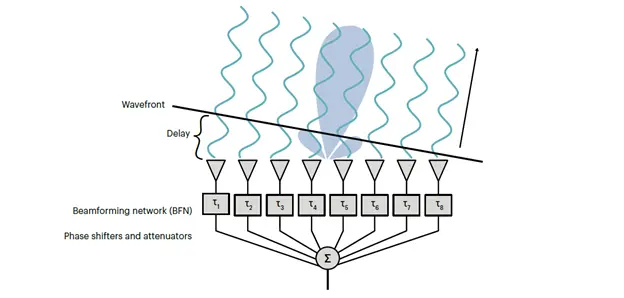
Source: Keysight
Rectennas
A rectenna, or rectifying antenna, operates by a different principle compared to both parabolic antennas and phased arrays. The advantage of a rectenna is that it can be made very lightweight by using a grid of individual dipoles combined into a single, flexible mesh. Such a mesh is easily mass-produced, easy to airdrop to remote locations, and can be made much larger in size than a conventional single parabolic dish (which is limited to around 70 meters in size2). Moreover, they are more flexible and can take up less space as they do not need to be parabolic in shape - they can easily be made into flexible flat sheets, rolled up for transport, and unrolled at their destination. Unlike phased arrays, they do not (generally) need very complicated electronics/computers. Finally, another attractive feature is that they can be made extremely efficient — in fact, an efficiency of 90% can be reached for experimental designs3.
At the most fundamental level, a rectenna is simply an antenna – any type of antenna – connected to a rectifier (a device that converts AC current to DC). This means that in theory, a parabolic antenna or phased array connected to a rectifier would qualify as a rectenna. In practice, rectennas generally refer to a more specific type of design, where a dipole antenna (or more practically, an array of dipoles) are connected to rectifying diodes, such as Schottky diodes, that convert the incident microwaves to electrical power.
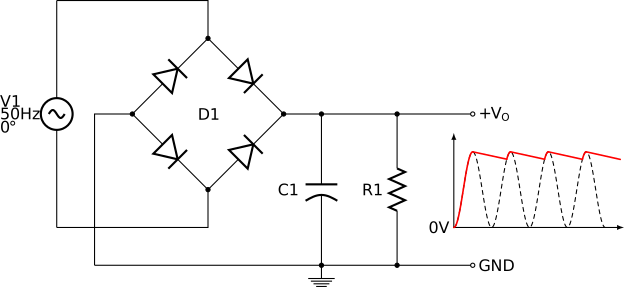
Source: Wikipedia

The above figure shows a typical configuration for a rectifier, composed of four diodes in a diamond pattern, as well as one capacitor & resistor each. The above AC source is an idealized model of the antenna; a typical dipole antenna has an impedance of around and a resonant frequency in the GHz range. Such a combination of a rectifier and antenna is thus a rectenna that can convert power from microwaves into electricity.
Footnotes
-
This is the size of NASA’s Deep Space Network’s largest antenna dish, which is among the largest in the world. ↩
-
See this PhD thesis (Zhang J., 2000) ↩